// blog
What AI Filmmaking Taught Me About AI Adoption
July 28, 2026 ·airesearchfilmmakingfuture-of-work
I recently ran a deep-research project into a single question: why hasn’t AI “solved” filmmaking yet? The models can generate stunning footage. Studios have signed landmark deals. Yet AI-native feature films keep stalling, and working filmmakers remain deeply ambivalent.
I consolidated results from dozens of research passes — searches, claim extraction, and adversarial verification where independent checks had to agree before I kept a claim (two claims failed verification and were thrown out). What emerged is a case study in how AI adoption actually goes when it collides with a demanding, real-world craft. I think the lessons generalize far beyond film.
Finding 1: The last 10–20% is where adoption dies
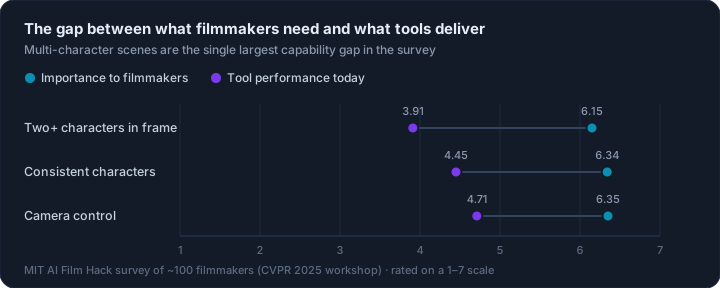
The industry’s #1 unsolved technical problem is character consistency — keeping the same face, body, and identity across shots. An MIT survey of ~100 filmmakers (CVPR 2025 workshop) rated consistent-character generation 6.34/7 in importance against just 4.45/7 in tool performance, and putting two consistent characters in one frame is the single largest capability gap in the survey. The best current practice — LoRA fine-tuning plus reference conditioning plus carefully weighted prompts — plateaus around 80–90% consistency.
That sounds close. It isn’t. One documented case: a director abandoned a 15-minute short after eight weeks because his lead “looked like three different people.” Runway built Gen-4 specifically to fix this, and its own showcase films still show identity drift.
The general lesson: for any serious craft, an AI tool that’s 85% reliable isn’t 85% useful. The remaining 15% is where projects quietly fall apart — and where adoption stalls no matter how good the demos look.
Finding 2: The visible cost is the tool; the real cost is iteration
The 95-minute AI feature Hell Grind cost about $500K — and $400K of that was compute. Its first 25 minutes took 16,181 generations to yield 253 usable shots: a ~1.6% hit rate. Getting consistency required prompts approaching 3,000 words, so the studio built a dedicated internal tool just to write them. Survey teams report 30–40 variations per prompt as standard practice, and filmmakers average 3.14 different tools per film because no single one covers the workflow.
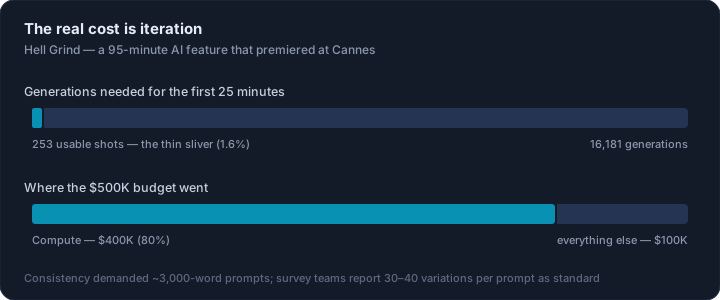
The general lesson: AI adoption costs live in the iteration loop, not the license fee. When output is probabilistic, “cheap generation” multiplied by a 1.6% yield is not cheap — and organizations that don’t measure their yield rate don’t actually know what AI costs them.
Finding 3: Some failures are model-level, and no amount of prompting saves you
On physics benchmarks (T2VPhysBench, May 2025), all ten state-of-the-art video models scored below 0.60 in every physical-law category — the best averaged 0.42. Adding physics hints to prompts often made results worse. Learned prompt-refinement techniques claw back real but partial gains — roughly eleven points, helping without solving. Narrative benchmarks show the same shape: models that score 0.775 on visual quality manage 0.252 on narrative coherence, reversing cause and effect and dropping actions from multi-step instructions.
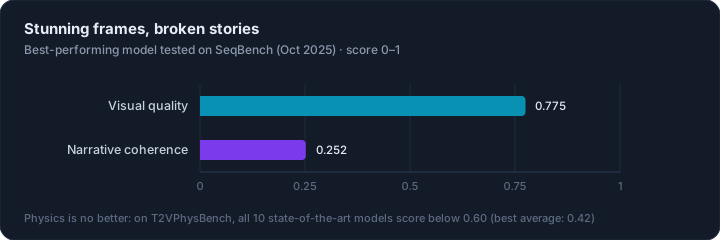
The general lesson: know which of your problems are prompt-level and which are model-level. Prompt-level problems reward skill investment today. Model-level problems only yield to the next model generation — and betting a production on them is how you end up eight weeks in with nothing shippable.
Finding 4: Platform dependency is an existential risk, not an IT concern
Sora was withdrawn in March 2026 — reportedly losing millions per day — less than three months after a landmark Disney deal, orphaning projects mid-production, including OpenAI’s own $30M feature Critterz, which missed its planned Cannes debut. The Lionsgate–Runway partnership quietly rescoped from “generate a franchise film in hours” to previsualization and storyboards, partly because even a 20,000-title catalog turned out to be too small to train a useful custom model.
The general lesson: when your workflow depends on a hosted frontier model, a vendor’s business decision can erase your work overnight. The adoption question isn’t just “does the tool work?” but “what happens to everything we built if it disappears?”
Finding 5: The social license lags the technology — by a lot
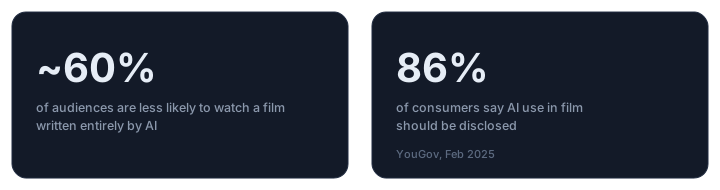
Around 60% of surveyed audiences say they’re less likely to watch a film written entirely by AI, while 86% of consumers want AI use disclosed (YouGov, Feb 2025).
Acceptance holds for assistive uses — VFX, translation — and collapses when AI replaces actors or writers. The backlash is instant even for hybrid work: The Brutalist’s modest accent-tuning disclosure triggered calls for awards disqualification. Meanwhile the rules are being written in real time: the US Copyright Office ruled that prompts alone confer no authorship (human selection and arrangement of AI output is protectable), SAG-AFTRA locked in consent requirements for digital replicas, and a “Human Provenance in Film” disclosure standard launched at Cannes in 2026.
The general lesson: every industry adopting AI will hit this same wall — customers and regulators distinguish sharply between AI that assists humans and AI that replaces them, and disclosure is becoming infrastructure, not courtesy.
What this predicts about the future
Putting the findings together, my read on AI adoption anywhere — not just in film:
- Assistive-first is the durable path. The adoption that sticks (previz, storyboards, VFX cleanup) augments human judgment; the moonshots that replace it keep collapsing on the last 10–20%.
- Reliability, not capability, is the frontier. The gap between a great demo and a shippable product is measured in yield rate, and closing it is worth more than another leap in raw quality.
- Provenance becomes a market. Copyright-clean training data and human-authorship documentation are already emerging as competitive differentiators. Trust infrastructure is the next tooling layer.
- The winners redesign workflows. Hell Grind had to build custom prompt tooling to function at all. Bolting AI onto old processes captures little; rebuilding the process around AI’s actual failure modes captures a lot.
Filmmaking is just the industry hitting these walls first, in public, with the receipts visible. The rest of us get to learn from it before our own 1.6%-yield moment arrives.
If you’re researching AI adoption in another domain and seeing patterns that confirm or contradict this, I’d genuinely like to compare notes — the contact page is the best way to reach me.